On a January morning in 1935, if you stood on the bluff above Paradise Cove and looked out, you would have seen a 900-ton steam schooner anchored roughly a mile offshore, flanked by two smaller vessels called the Hawk and the Port Saunders. Their decks were slick with whale blood and their holds were full of meat. Over the previous four weeks, those two "killer boats" had delivered twenty-four California gray whales to the factory ship. It was the best month the California Whaling Company had ever had.
Most people who live in Malibu today have no idea this happened. It's not in the tourist brochures, it's not on the Paradise Cove history plaques, and it's not on the signage along Westward Beach Road. But for roughly five years in the mid-1930s, the private cove that is now one of the most photographed beaches in California was the base of operations for one of the last commercial whaling fleets on the Pacific Coast.
The Ship, the Killer Boats, and the Captain's Son
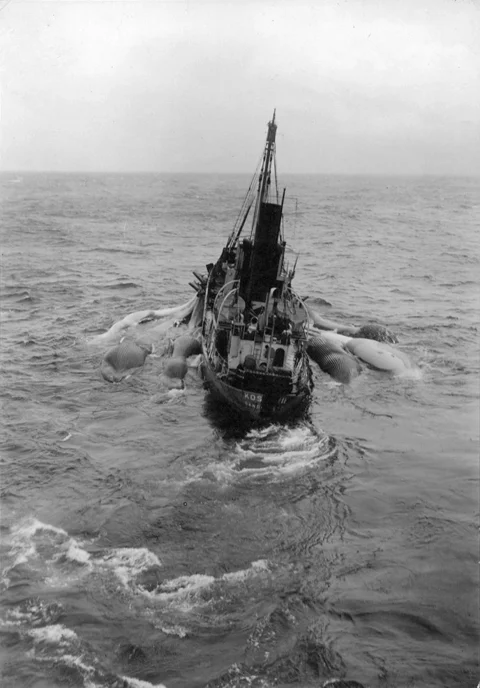
The factory ship was called the California. It had started life as a lumber schooner called the Willamette before Captain F.N. Dedrick, a Norwegian whaling veteran, bought it and converted it into a floating whale-processing plant. At 900 tons, it was small compared to the 7,500-ton Lansing the company had operated earlier from San Clemente Island, but the California carried one piece of technology that almost no ship of its era could match: onboard refrigeration. That meant it could work a grounds for weeks at a time, anchored offshore, and process whales at sea without ever needing a shore station.
The California first appeared in Southern California waters in August of 1932, flagged as belonging to the California Sea Products Company (later reorganized as the California Whaling Company). Captain Dedrick's logic was simple. The eastern North Pacific gray whale migration tracked the West Coast close to shore every winter, traveling about 12,000 miles round trip between the Arctic feeding grounds and the Baja calving lagoons. A mobile factory ship anchored a mile off a Malibu headland could harvest that migration more efficiently than any fixed shore station. His son, Captain Frederick N. Dedrick Jr., ran day-to-day operations as general manager.
The two killer boats handled the actual hunting. The Hawk and the Port Saunders each carried a harpoon gun mounted on the prow, fired by a gunner standing on a narrow walk between the pilothouse and the weapon. When a whale was sighted, every movement of the boat was directed by the gunner. A successful strike meant the whale was towed back to the California, where the cutting and processing began.
Fifty Whales in a Month, and Where the Meat Went
By late January 1936, a reporter named Emerson Gaze spent a day with the fleet and filed a dispatch that documented what the operation was actually producing. Over the previous several weeks, the fleet had caught more than fifty whales, nearly all gray, with a handful of humpback and sperm whales mixed in. A few months earlier they had taken a 90-ton sulphur-bottom whale (a blue whale) described at the time as "the largest mammal taken in these waters in many years."
What happened to that meat is one of the strangest details of the whole story. The California carried refrigerated cargo holds, and the premium cuts, frozen whale steaks and roasts, were destined for human consumption. The cheaper cuts went to a pet food manufacturing plant in Los Alamitos. The oil, rendered from blubber at a rate of roughly 600 barrels a month, went north to a Procter & Gamble soap plant. A single blue whale taken a mile off Paradise Cove could end up, in the same season, as a Malibu dinner, a bowl of dog food in Orange County, and a bar of soap in someone's bathroom in Cincinnati.
The Accident of March 16, 1936
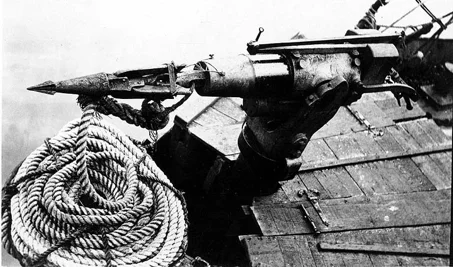
Whaling is dangerous work. The harpoon gun on a killer boat fires a metal harpoon with enough explosive force to penetrate a whale's hide, and the gun's breech recoils hard after each shot. On the afternoon of March 16, 1936, the crew of the Port Saunders was working a whale off the Santa Barbara coast when the harpoon gun fired and the breech recoiled wrong. It struck Captain Frederick N. Dedrick Jr. in the chest.
They made the fourteen-mile run to Santa Barbara Hospital as fast as they could, but Dedrick Jr. died from internal injuries and blood loss a few hours later. He was 40 years old. He left a widow, two sons who were enrolled in schools in San Francisco, and his parents in San Pedro. With his death, the California Whaling Company suspended operations entirely. The California and its killer boats sat idle at anchor for the next fifteen months.
The End of Pacific Coast Whaling
While the company's boats sat still, the regulatory ground shifted under them. In 1936, the United States gave gray whales protected status. The following year, the first international treaty on commercial whaling placed partial restrictions on gray whale hunting, limiting the season to the narrow November-through-February window. When the company's receivers finally reactivated the California and its killer boats in July of 1937, one of the first notes in the trade press observed that "many huge gray whales are reported off shore, but they may not be taken except between November and February under recent international treaty."
The economics had stopped working. An August 1937 filing described the California Whaling Company as "the only whaling operations on the Pacific Coast," which is another way of saying that every other California whaler had already walked away from the business. On March 31, 1939, the California, the Port Saunders, and the Hawk were sold at a bankruptcy auction to a San Francisco buyer named John R. Griggs, who reconditioned the ships and put them into the shark-fishing trade off the California coast. The last whaling fleet to work the Malibu shoreline simply stopped existing.
Recovery and Preservation
The recovery has been one of the great conservation success stories of the West Coast. The International Whaling Commission granted full international protection to gray whales in 1947. The Marine Mammal Protection Act of 1972 made it illegal to hunt any marine mammal in U.S. waters. The eastern North Pacific gray whale population, which had been hunted to the edge of extinction twice (once in the 1850s after whalers found the calving lagoons, and again in the early 1900s with the arrival of floating factory ships), has since recovered to somewhere between 19,000 and 23,000 animals, close to its estimated pre-whaling population.
On January 1, 2012, the California Department of Fish and Wildlife established the Point Dume State Marine Reserve and the Point Dume State Marine Conservation Area, a pair of Marine Protected Areas covering nearly five miles of Malibu's shoreline from Paradise Cove to El Matador. The protection extends from the mean high-tide line down to depths greater than 2,000 feet. The Reserve bans all fishing and harvesting. The Conservation Area allows only limited recreational and commercial take. Between them, they fully include the mile-offshore anchorage where the California once floated. What had been an industrial whaling station in 1935 is now, by California law, one of the most protected stretches of ocean in Southern California.
The gray whales still migrate past Malibu every winter and spring, as they did when the Hawk and the Port Saunders were working those waters. You can watch them from the headland at Point Dume, or from the bluff above Paradise Cove itself, usually mid-December through mid-April. The whales moving past Paradise Cove today are descendants, four or five generations removed, of the whales the California Whaling Company didn't get.
Malibu's Historic Land
Part of what makes owning a home in Malibu different from owning a home elsewhere is the length of the historical arc the coastline carries. The same stretch of water went from a Chumash fishing ground to a Spanish land grant to a Rindge family cattle ranch to a whaling factory to a Hollywood filming location to a Marine Protected Area inside a single century. It is rare to own a piece of land whose recent history is still being rewritten, and thankfully in the direction of preservation rather than development.
We've been selling homes in Malibu for 25 years, and every so often a buyer asks us what's actually different about this coast compared to any other stretch of the California shoreline. This kind of story is part of the answer. A deep history and legacy of conservation and natural beauty. Today Malibu is one of the most exclusive and well preserved slices of coast in Southern California.
For the cove's other chapters, our longer history of Paradise Cove picks up the timeline from the pier era forward, through the Marilyn Monroe years and the Rockford Files shoots and the Roberts family's ongoing stewardship.
Shen Schulz
Sotheby's International Realty
(310) 980-8809 | shen@shenrealty.com | DRE #01327630
Sources
- Islapedia, "Whales" historical entry on Pacific Coast whaling operations – https://www.islapedia.com/index.php?title=WHALES
- Nial O'Malley Keyes, Blubber Ship, George G. Harrap & Co., London, circa 1939
- Topanga New Times, historical coverage of Paradise Cove whaling operations – https://topanganewtimes.com/
- Wikipedia, "Point Dume" – https://en.wikipedia.org/wiki/Point_Dume
- NOAA Fisheries, Gray Whale Species Profile – https://www.fisheries.noaa.gov/species/gray-whale
- California Department of Fish and Wildlife, "Point Dume State Marine Reserve and State Marine Conservation Area" – https://wildlife.ca.gov/Conservation/Marine/MPAs/Point-Dume
- International Whaling Commission historical records – https://iwc.int/commission/convention
- Marine Mammal Protection Act (1972), NOAA Office of Protected Resources – https://www.fisheries.noaa.gov/topic/laws-policies/marine-mammal-protection-act