In the summer of 1956, a five-foot tenth grader named Kathy Kohner started showing up at the First Point of Surfrider Beach with a homemade peanut-butter-and-radish sandwich and a borrowed surfboard. She didn't know it yet, but she was about to give Malibu the most enduring piece of cultural mythology it would ever have.
Within three years, her name, or rather, the nickname the local surfers gave her, would be on movie marquees across America. Within five, "surf culture" would be a global phenomenon. Within fifty, the wave she learned to ride would be named the first World Surfing Reserve on Earth.
She just wanted to learn how to surf.
A Hollywood Refugee's Daughter at the Malibu Lineup
To understand how Gidget happened, it helps to know who Kathy Kohner was before that summer.
Her father, Frederick Kohner, was an Austrian-Jewish writer born in 1905 in what was then the Habsburg Empire and is now the Czech Republic. He'd earned a doctorate at the University of Vienna with a thesis on film aesthetics, worked as a critic and journalist in Prague and Berlin, and broken into the German film industry in 1930. By 1935, the Nazis had stripped his name from a film he'd written. In July 1936, he fled with his wife and young daughter to Los Angeles, where his brother Paul was already an established Hollywood agent. Frederick rebuilt his career as a screenwriter, eventually earning an Oscar nomination, and settled the family in West Los Angeles.
Kathy was born in 1941, the second daughter. She grew up in a household full of European intellectuals and Hollywood writers. Then, in 1956, a friend dragged her down PCH to a beach she'd never heard of, and her life pivoted on the spot.
The wave at First Point, the long, peeling right-hand point break that wraps around the Malibu Lagoon, was already legendary among the small fraternity of California surfers. The lineup was male, territorial, and unwelcoming to outsiders. It was also full of characters who would become the founding pantheon of California surf culture.
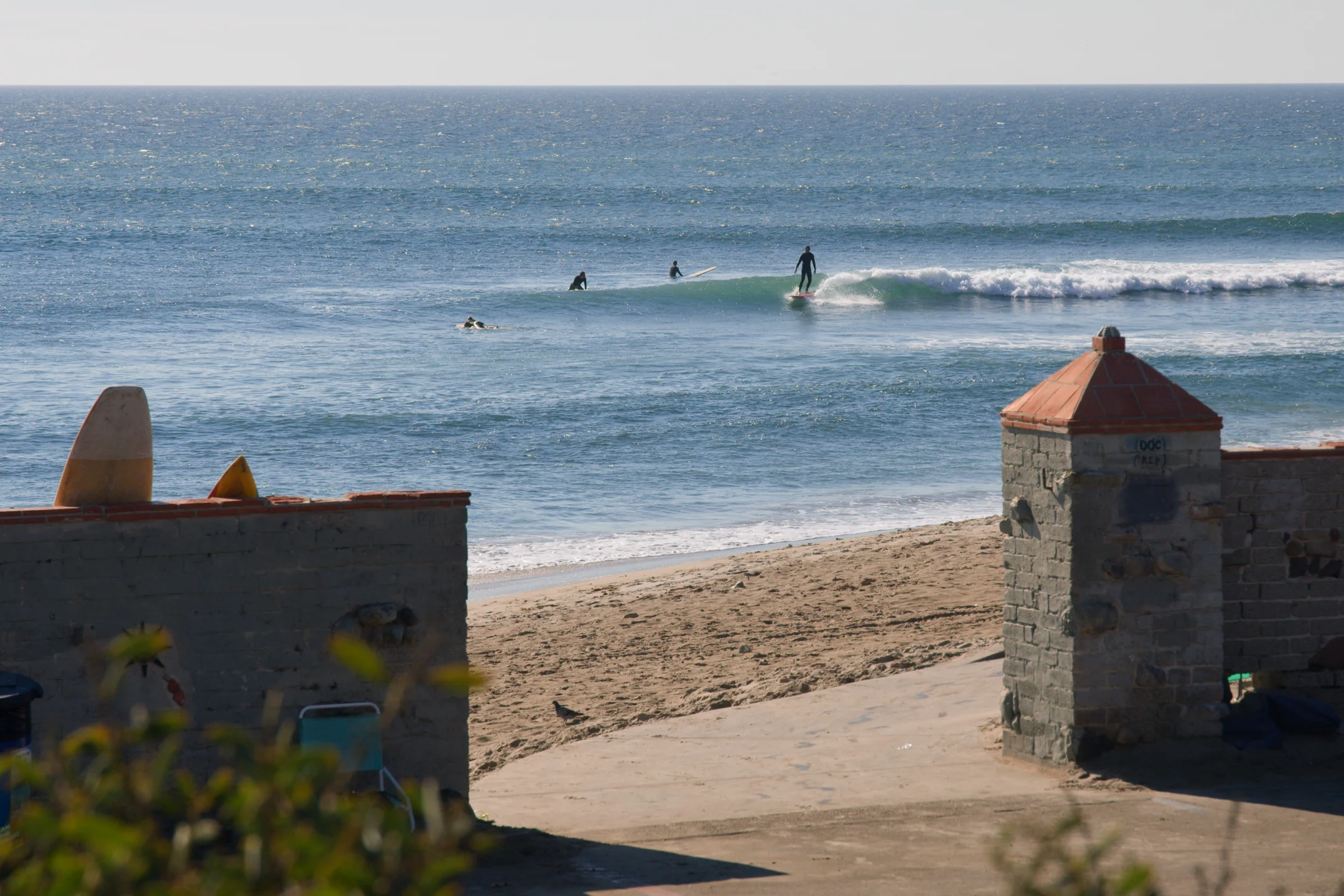
There was Terry "Tubesteak" Tracy, who lived in a driftwood shack on the sand and presided over the beach scene like a barefoot mayor. There was Miki "Da Cat" Dora, the dark-eyed, magnetic, vaguely sinister stylist who would become the most influential and most argued-about surfer of the twentieth century. There was Mickey Muñoz, Mike Doyle, Lord Blears, "Thrifty Phil," "The Fencer," and "Scooter Boy." They had a code, a slang, and an aesthetic, and they did not, as a rule, want a fifteen-year-old girl from Brentwood paddling out among them.
Kathy persisted. She showed up day after day. She bought an 8-foot-6-inch balsa surfboard from a young shaper named Mike Doyle for $35, a price she paid in part with her cache of homemade peanut-butter-and-radish sandwiches, which she handed out to the crew. She had, by her own cheerful admission, a major crush on a surfer named Bill Jensen and stuffed tissue in the top of her bathing suit. She fell off her board, got back on, and kept coming back.
Eventually the lineup adopted her as a kind of mascot. Tubesteak, looking down at the small, eager teenager who'd just paddled out beside him, gave her a portmanteau nickname that stuck for the rest of her life and rewrote American pop culture in the process: girl + midget = Gidget.
"I was so happy to get that name," she would say later. "I was like, 'I'm Gidget!'"
A Diary, a Novel, and an Accidental Phenomenon
What happened next is the part of the story almost nobody gets right.
Kathy was a teenage girl having the summer of her life. Naturally, she came home every night and told her father about it, in long, breathless monologues full of slang she'd picked up at the beach, descriptions of surfers and waves and the politics of the lineup. She kept a diary. At one point, she announced that she wanted to write a book.
Frederick Kohner, the European intellectual screenwriter, listened to his daughter's beach-bum patois and made her an offer: You're not a writer. Tell me the stories, and I'll write them.
She did. He wrote. In a matter of weeks in early 1957, he produced a slim novel called Gidget, the Little Girl with Big Ideas, narrated in the voice of a sixteen-year-old girl learning to surf at Malibu and wrestling with everything that comes with being sixteen. He kept the slang, the characters (with names lightly fictionalized, "Kahuna" was Tubesteak, "Moondoggie" was the love interest), and the geography. He sold it to G.P. Putnam's Sons.
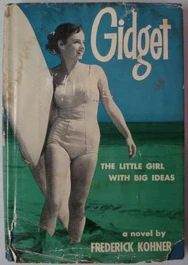
It became a bestseller almost immediately. Columbia Pictures bought the film rights within months.
The 1959 movie Gidget, starring Sandra Dee as the teenage surfer and James Darren as Moondoggie, became one of the highest-grossing films of the year. It was followed by Gidget Goes Hawaiian (1961) and Gidget Goes to Rome (1963). Then came a 1965 ABC television series that launched the career of an unknown twenty-year-old named Sally Field. Then made-for-TV movies: Gidget Grows Up, Gidget Gets Married, Gidget's Summer Reunion. Then a 1986 syndicated revival, The New Gidget, with Caryn Richman in the lead. Frederick Kohner went on to publish seven more Gidget novels.
The cultural impact was disproportionate to anything anyone in 1956 could have imagined. Gidget didn't just popularize surfing, it invented the idea of the teenage beach movie, the surf-pop song, the woody-station-wagon-and-malt-shop California summer. It launched the Beach Boys' commercial moment. It drew thousands of teenagers to Malibu in the early 1960s, transformed the West Coast's image of itself, and ultimately turned surfing from a fringe Polynesian and Californian subculture into a global multibillion-dollar lifestyle industry.
The Encyclopedia of Surfing put it this way: Gidget did more to bring surfing to the masses than anything since Duke Kahanamoku's world tour.

The actual surfers at First Point were not, on the whole, thrilled. Miki Dora in particular felt that the movie had ruined Malibu, flooded the lineup with kooks, made his sacred wave a tourist attraction. He spent the rest of his career half-mythologizing and half-cursing the Hollywood version of the place he'd helped create.
But the genie was out of the bottle. The wave, the beach, and the town were now world-famous.
The First World Surfing Reserve
Fast-forward fifty-four years.
In October 2010, Save The Waves Coalition, an environmental nonprofit working to protect surf ecosystems, formally dedicated Surfrider Beach in Malibu as the very first World Surfing Reserve on Earth. It was a global designation, the surfing equivalent of being named a UNESCO heritage site. There are now twelve World Surfing Reserves across the planet, in places like Ericeira, Portugal; Bahía de Todos Santos, Mexico; the Gold Coast of Australia; and Santa Cruz, California. Malibu was the first one.
The selection committee cited four reasons: "the stellar quality of its waves, the seminal role it played in the birth of modern surf culture, the rich biological characteristics of its besieged inland wetlands, and the protective galaxy of locals caught in its gravitational field."
Translation: it's a perfect wave, it's where modern surfing was born, the lagoon ecosystem is irreplaceable, and the people who love it will fight for it. All four of those things trace, in part, back to a teenager with a peanut-butter-and-radish sandwich.
Gidget, Still Showing Up
Kathy Kohner-Zuckerman is now eighty-five years old. She married a Yiddish scholar named Marvin Zuckerman in 1965. They raised two sons. For sixty years they lived in a modest house on Marquette Street in the Marquez Knolls neighborhood of Pacific Palisades, just up the canyon from the beach where she'd become Gidget.
For more than two decades, she's been the official "Ambassador of Aloha" at Duke's Malibu, the surf-themed restaurant on PCH named for Duke Kahanamoku. On Saturdays and Sunday brunches, she greets guests, signs copies of the books, tells the stories, and embodies, gently, warmly, without ego, the spirit of the wave just down the road.
Then came January 7, 2025.
The Palisades Fire tore through Marquez Knolls and incinerated fifteen of the sixteen homes on Marquette Street. Kathy and Marvin lost their house, a rental property next door, and almost everything inside: photo albums, diaries, the books her father had inscribed to her, her grandmother's portrait, dishes carried over from Europe in 1936, a postcard collection sixty years in the making, Marvin's library. They evacuated in separate cars. They reached the Fairmont Hotel in Santa Monica that night, where Kathy spent her eighty-fourth birthday and the couple's sixtieth anniversary.
She was, in the manner of a person who has lived a long life, philosophical about it.
"It's sad. It's just so sad. We lost our home. Everything in it. What can you do?" she told Defector. "We're safe and that's the main thing." She quoted a friend: "You didn't pack up and get shipped to Auschwitz." And then, simply: "Ashes to roses. That's what I want: roses."
Duke's Malibu, improbably, miraculously, survived the fire. When the restaurant fully reopened, Kathy's "Ambassador of Aloha" gig was waiting for her.
She still goes. She still tells the stories. She still smiles at the wave.
Why It Matters to Malibu
Most coastal towns have a beach. Malibu has a creation myth.
Surfrider Beach is the place where a fifteen-year-old refugee's daughter, the lineup of misfit characters who adopted her, and a Hollywood screenwriter who'd fled the Nazis with a four-year-old daughter and a typewriter all collided to invent something the world hadn't seen before, a culture, a lifestyle, an entire imaginative geography of California sun. Sixty-eight years later, the wave is the first World Surfing Reserve on the planet. The beach is a global pilgrimage site. The town's name is shorthand for a kind of life.
That's not a real estate fact. It's not in any market report. But it's part of what people are buying into when they choose Malibu, a place whose identity was formed not just by geography but by a single, almost accidental summer in 1956, and the small, persistent, peanut-butter-sandwich-bearing teenager at the center of it.
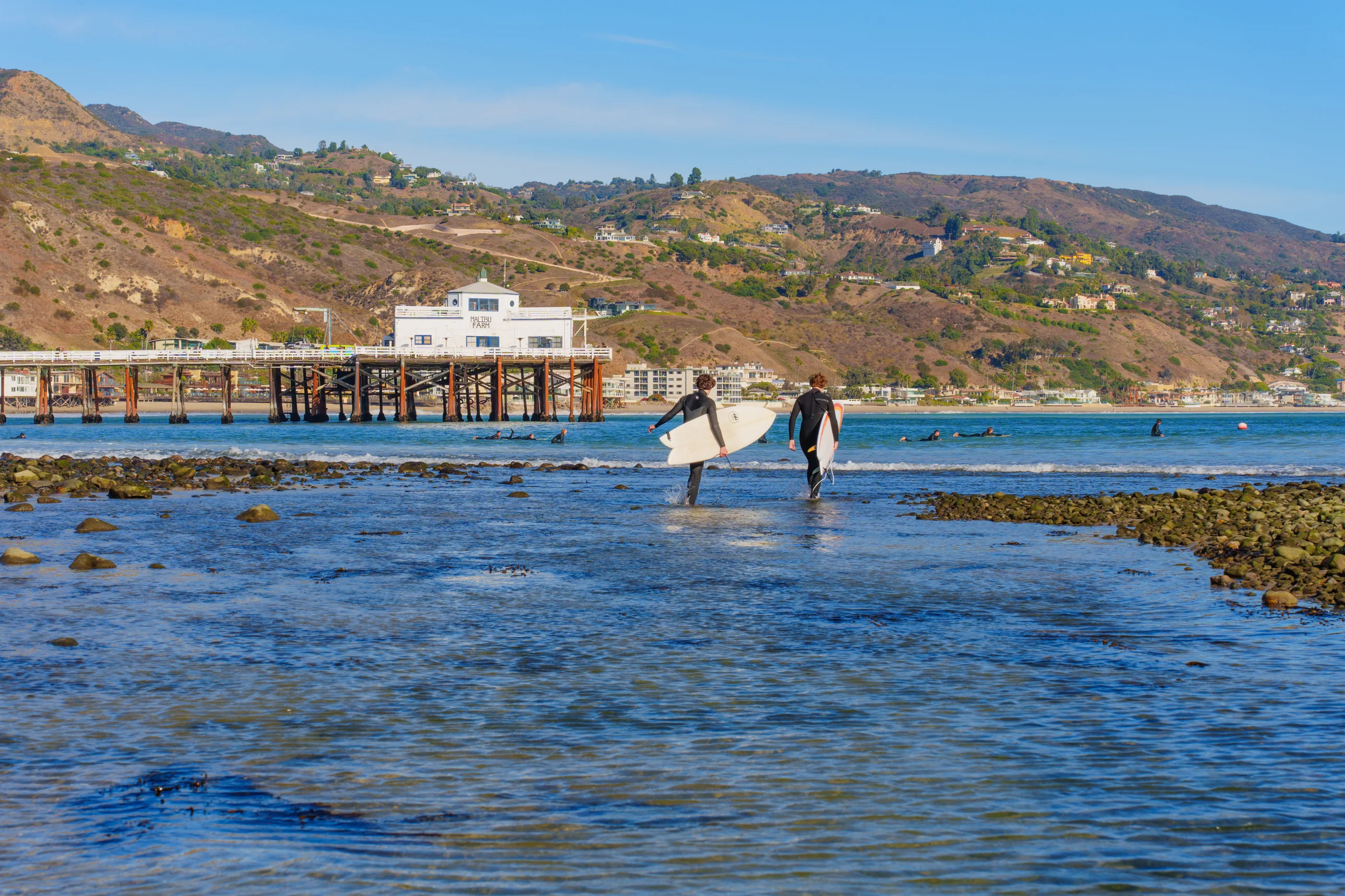
She's still here. So is the wave.
Next time you're driving past Surfrider on PCH — or paddling out into that long, perfect right — it's worth remembering that you're standing on the original ground floor of surf culture. And that the woman who started it might be a few miles down the road at Duke's, on a Saturday afternoon, signing a book.
Shen Schulz
Sotheby's International Realty
(310) 980-8809 | [shen@shenrealty.com](mailto:shen@shenrealty.com) | DRE #01327630
Sources
- Encyclopedia of Surfing, "Gidget" – https://www.eos.surf/encyclopedia/gidget
- Wikipedia, "Kathy Kohner-Zuckerman" – https://en.wikipedia.org/wiki/Kathy_Kohner-Zuckerman
- Wikipedia, "Frederick Kohner" – https://en.wikipedia.org/wiki/Frederick_Kohner
- Save The Waves Coalition, "Malibu World Surfing Reserve" – https://www.savethewaves.org/malibu/
- Defector, "Gidget The Survivor" – https://defector.com/gidget-the-survivor
- Surfer Magazine, "Surf Icon Gidget Loses Home in Palisades Fire" – https://www.surfer.com/news/surf-icon-gidget-loses-home-palisades-fire
- Duke's Malibu, official website – https://www.dukesmalibu.com/Malibu/